WIRE — A Personal Newswire for Uptown Phoenix
When I started Uptown Media Systems, it had a television network and a radio station. Both were built around the same idea: turn something on and find that it is already happening.
Eventually I wanted an information version of that. Something I could glance at in the morning without opening five apps, scrolling through their feeds, and accidentally learning what a stranger thinks about breakfast.
That became WIRE.
WIRE — Morning Transmissions goes out at 7:00 AM Phoenix time. SIGNAL — Event-Driven Transmissions is the companion channel for alerts that arrive when something happens. You can open either topic in a browser or subscribe through ntfy.
The morning transmission
WIRE is a small daily briefing for Uptown Phoenix. It puts the weather, sports, and one piece of local information into a single message. The form matters as much as the contents: short lines, all caps, and just enough structure to find what I need without reading an essay before coffee.
Here is the October 6 morning transmission:
WIRE / OCT 6 / 0700 MST
WX 81F | Sunny
HIGH 100 | TONIGHT 78

SPORTS
SUNS 107 PISTONS 109 FINAL
NEXT SUNS @ BULLS TOM 5:00 PM
CARDINALS 24 SF 36 FINAL
NEXT CARDINALS vs LIONS SUN 1:25 PM

ONE THING
EARTH DETOUR BETWEEN COLLEGE AVE./ FILLMORE ST. AND SCOTTSDALE RD./ FILLMORE ST.- CONSTRUCTION

UPTOWN PHX
The message has a little bit of everything I might otherwise go looking for. Weather first. Scores and the next games after that. Then ONE THING, a single item worth putting in front of me that morning. It is deliberately finite. When the transmission ends, I am done checking it.
That is the part I like most. I built a newswire so I could get less news at once.
A second channel for things that happen
Some information does not belong in a 7:00 AM briefing. An event might occur ten minutes later or halfway through the afternoon. SIGNAL gives that kind of update its own channel, separate from the predictable morning message.
The SIGNAL topic carries event-driven transmissions. Recent messages, for example, reported earthquakes with their magnitude, location, depth, distance from Phoenix, and a USGS time stamp. They read like dispatches from the same little information desk, but they do not need to wait for tomorrow’s WIRE.
Keeping the channels separate makes them easier to use. I can check WIRE for the morning summary and decide whether I want to subscribe to SIGNAL’s alerts. One is a ritual. The other is a tap on the shoulder.
The delivery system
Both channels use ntfy, an open-source push notification service that can send messages through simple HTTP requests. A script can publish to a topic, and a phone or desktop subscribed to that topic receives the message. It is a pleasingly small piece of infrastructure for this job.
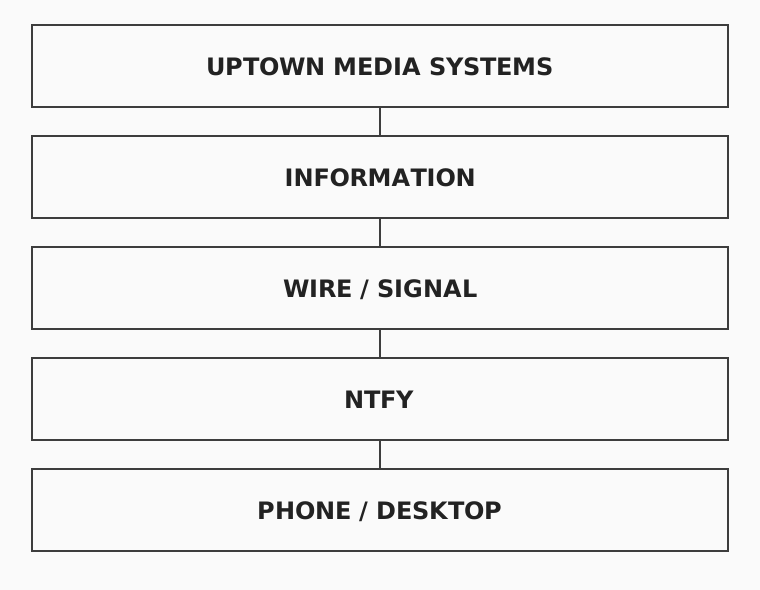
I like that the delivery mechanism stays out of the way. The point is not to build another destination I have to remember to visit. The information can come to me in a format I made for myself.
Another department at UMS
BGTV is television that is already on. KMAT is radio that is already playing. WIRE and SIGNAL apply the same instinct to information: give it a schedule when a schedule helps, and let an event speak when it happens.
None of this required inventing a fictional media company. But once the company existed, it seemed only right that it should have a wire service.
Tune in: WIRE — Morning Transmissions · SIGNAL — Event-Driven Transmissions